Home › Indoor Air Quality
Indoor Air Quality & Whole-Home Dehumidifiers in Columbia, TN
If your house feels sticky at 72 degrees, the windows fog, or the vents smell musty, the problem is moisture, and Columbia summers deliver plenty of it. Most homes here feel right at 40–50% relative humidity. We find why yours runs higher — airflow, sizing, crawl space moisture, or duct leaks — then fix the cause, with a whole-home dehumidifier in Columbia, TN when the house truly needs one.
5-star ratedLicensed & insured in Tennessee25 years in businessColumbia, TN · Price in writing before work starts
Why Columbia houses run damp
The muggy season is long
Mid-May to late September, the air itself is wet. Every open door and every duct leak pulls that moisture in, and a vented crawl space adds more from below.
Oversized AC short-cycles
A too-big system cools the air fast and shuts off before it pulls moisture out. The house reads 72 and feels like a greenhouse. This is the most missed cause we see.
The crawl space feeds the house
Air moves upward through a house. Moisture and musty smell from a damp crawl space ride with it. See our crawl space page — sometimes the fix starts under the house, not at the unit.
Humidity, by the number — where your house sits
“Damp” is an argument. A number is not. A cheap gauge or a humidity-reading thermostat ends the debate, and this scale is how we read the result:
| Your reading | What you feel and see | First move |
|---|---|---|
| 40–50% | House feels right at a normal setting; no window fog, no musty smell | Nothing. This is the target — hold it there |
| 50–55% | Slightly clammy on muggy weeks; you nudge the thermostat down to feel dry | Check airflow, filter, and duct leaks first — the free causes |
| Over 55% most days | Sticky at 72°, musty smell at start-up, condensation, spots in closets and bathrooms | Measure the crawl space too. Oversized AC, crawl moisture, or both — then a whole-home dehumidifier earns its place |
| Under 30% in winter | Static shocks, dry skin, gaps in wood floors, sore throats in the morning | Seal the obvious air leaks first; a humidifier is the second step, not the first |
“The AC runs, but the house is still humid”
That sentence is the most common way this problem gets described, and it is a useful one: the temperature is right and the comfort is wrong. An AC removes moisture only while its coil runs cold — a system that short-cycles, is oversized for the house, or has airflow trouble can hit the thermostat setting and stop before it has dried the air. In heating season, a heat pump does not dehumidify at all. Either way, the order does not change: measure the humidity number, check the free causes (filter, airflow, duct leaks, crawl moisture), then decide whether the house needs drying equipment. Where damp air sits in a home over time, musty smells and visible growth on damp surfaces are the homeowner-level signs — the fix is drying the source and holding the number in range, which is the work laid out below.
What we install and service
- Whole-home dehumidifiers tied into the duct system, draining on their own — no bucket to empty, and the house can sit at a higher thermostat setting and still feel dry
- Better filtration: media filters and air cleaners sized to your blower, so cleaner air does not come at the cost of airflow
- Humidity-reading thermostats that show you the number, so “damp” becomes a measurement instead of an argument
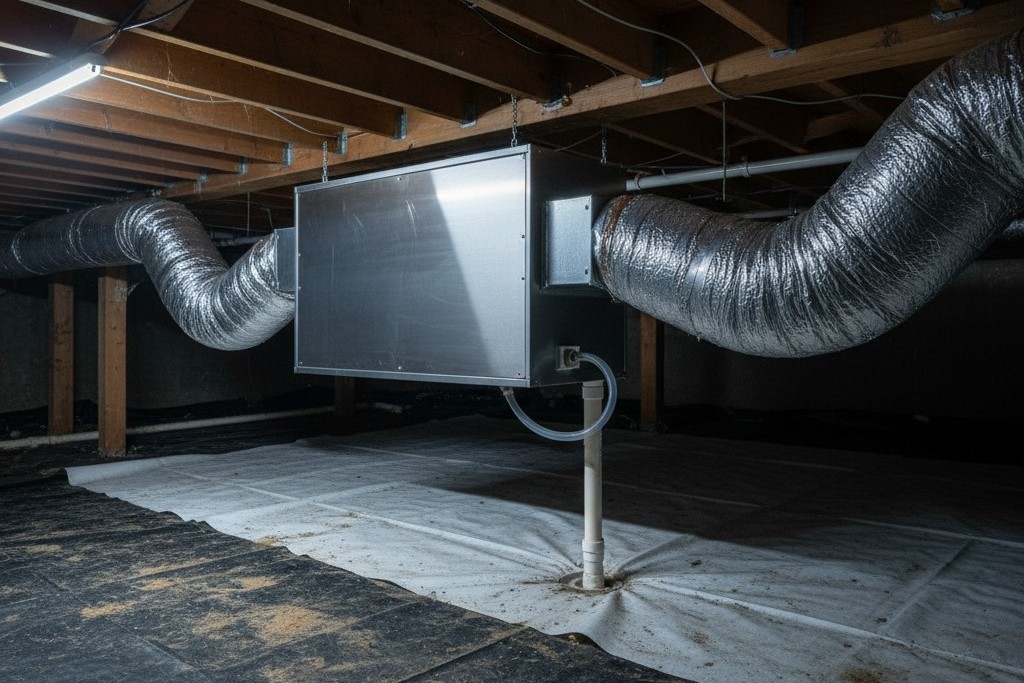
Portable vs whole-home dehumidifier
| Portable unit | Whole-home unit | |
|---|---|---|
| Covers | One room, with the door open | The whole house, through the ducts |
| Water goes | Into a bucket you empty — or it shuts off full | Down its own drain line, on its own |
| Control | Its own dial, room by room guesswork | One setting at the thermostat or its control |
| Honest fit | One damp room while you fix the cause | A house that measures over 55% most of the summer |
Either way: fix the water source first. A dehumidifier drying air above a wet crawl space is a bandage on a leak.
Fix order for indoor air: source first, gadgets last
Measure, do not guess
A humidity reading at the thermostat and one look at the crawl space tell us more than a shelf of air gadgets. Numbers first.
Stop the water
Clogged drains, sweating ducts, crawl moisture, a pan that never dries. Wet is the source of most musty air in Maury County homes.
Fix the air path
Filter fit, leaky returns, crushed runs. A return pulling crawl air delivers that air to every bedroom, filter or no filter.
Right-size the drying job
If humidity still sits over 55% with the sources fixed, a whole-home dehumidifier is sized to the house — not sold by the box.
Add-ons last, one at a time
Better media filtration, then a coil UV light if the coil grows growth. One layer, measured again, then decide if another earns its place.
What is likely in your air, room by room
| Room | Common load | First fix that actually helps |
|---|---|---|
| Bedrooms | Dust and dust-mite load in bedding and carpet; pollen tracked in on clothes in spring | Filter that fits and seals at the return; wash bedding hot in pollen season |
| Bathrooms | Shower moisture that never leaves; fan vented into the attic instead of outside, in some older homes | Run the fan 20 minutes after a shower; confirm the fan duct goes outdoors |
| Kitchen | Cooking moisture and grease that coat the coil over years | Range hood used every cook, vented outside where the house allows |
| Whole house, ranch on a crawl space | Crawl air rising through floor gaps and leaky returns | The crawl space work — no filter fixes air that enters after the filter |
A whole-home dehumidifier, installed — what the job actually involves
Other Columbia pages mention dehumidifiers inside a general air-quality answer and stop there. No local page we have read covers the sizing or the install, so here is the whole job:
Measure first, for real
A humidity reading at the thermostat across muggy days — not one sticky afternoon — plus a look at the crawl space and the ducts. If the reading sits at 50–55% and a duct leak explains it, the leak gets fixed and no box gets sold.
Size by pints, not by square feet alone
Dehumidifiers are rated by how much water they pull in a day. The right size counts the house’s size and its moisture load — a ranch over a wet vented crawl space loads a unit very differently from a slab home at the same square footage.
Tie into the return, with its own drain
The unit draws air from the duct system, dries it, and sends it back. Its condensate goes down a dedicated drain line with the same float-switch thinking that protects your AC — a dryer that floods a crawl space has missed the point.
One control, one number
The setting lives at the unit’s control or the thermostat: most Columbia homes hold 45–50% through the muggy season. You see the number daily, so “is it working?” stops being a guess.
Re-measure after it runs
Readings before and after, in writing. If the house does not hold the range, the cause gets revisited — sizing, a duct leak, crawl moisture — before anyone suggests a bigger box.
Living with one asks little: a filter to rinse or swap on schedule, a drain line checked when the AC drain is checked, and a quick look at the unit during the cooling tune-up. It has no bucket, makes no ice, and does its work whether anyone is home or not.
Proof on air-quality work, not promises
- Licensed & insured in Tennessee, based at 1230 Industrial Park Rd, Columbia
- Humidity readings before and after any install, in writing — the number is the finding and the number is the result
- Source-first honesty, on paper: if the fix order puts a duct repair or crawl-space work ahead of any box, that order is what the quote shows, in that order
- One layer at a time: filtration, humidity control, coil light — each added only when the measurement before it says the problem is still there
House cool but still sticky or musty?
That is a humidity and airflow question, not a temperature one. Call and we measure first — humidity, airflow, and the crawl space — then price only the fix that fits the reading.
Licensed & insured in Tennessee · ★★★★★ 5-star rated · 25 years in business · 1230 Industrial Park Rd, Columbia, TN
IAQ FAQs
Do I need a dehumidifier if my AC already runs all day?
Maybe not a bigger AC — maybe a dehumidifier. If the temperature is fine but humidity sits above 55%, the AC is doing its job and still cannot wring out enough moisture, often because it is oversized or the crawl space is feeding moisture in. We measure humidity and check the crawl space and ducts before recommending any box.
What MERV filter should I use?
Most home systems handle MERV 8 to 11 well. Jumping to a very high MERV in a system with a small return can starve airflow and freeze the coil — the filter is part of the system, not a separate purchase. Tell us your unit and return size and we will name the filter it can actually breathe through.
Portable dehumidifier or whole-home?
A portable unit dries one room, needs its bucket emptied, and fights the whole house’s moisture alone. A whole-home unit ties into the ducts, drains by itself, and holds the whole house at one setting. For a damp room over a crawl space, start by checking the crawl — a portable unit there is a bandage.
The vents smell musty when the AC starts. What is that?
Usually moisture and growth inside a wet drain pan, on a damp coil, or in duct liner that stays wet. The fix is finding where the water sits — drain, coil, or crawl-fed ducts — cleaning what can be cleaned, and drying the source. Scented sprays into the ducts hide it for a week.
Do UV lights and air purifiers actually work?
They do narrow jobs, not whole-house magic. A UV light at the coil can help with growth on the coil itself and the musty start-up smell that comes with it, as long as the coil and drain pan are kept clean — it does not clean the rest of the house. A better media filter catches more dust and pollen on every cycle. A plug-in unit in one room treats that room. None of them fixes humidity over 55%, a wet crawl space, or a dirty drain, so we measure first and add only the layer that fits the problem we found. Anyone offering you four air gadgets at once is selling boxes, not solving the complaint you called about.
Does my AC bring fresh air into the house?
No. A standard central system moves the same indoor air around — it cools it, filters it, and sends it back. It does not pull in outside air. If a house feels stale, the fix is planned ventilation, not a bigger filter — an ERV is the usual form of it, and it has its own page: ventilation & ERV. Most Columbia homes do not need one; they need the humidity and the duct leaks handled first.
Why are my allergies worse inside than outside — and what are the dark marks around my vents?
Start with what the system is pulling in. Leaky returns in an attic or crawl space draw unfiltered air — dust, pollen that settled up there, insulation fibres — and deliver it to every room, right past the filter. Dark marks around supply vents are often that same dirty air pattern showing on the ceiling, or a vent blowing against a cold surface where moisture collects. The check order is returns and filter fit first, humidity second, gadgets last.
Related work on this site
Damp air usually has a duct chapter and a schedule chapter: leaking ducts are priced on the duct repair & cleaning page, the twice-a-year checks that catch a failing drain early are on the maintenance & tune-ups page, fresh air itself — as opposed to the moisture in it — is the ventilation & ERV page, and the towns we fit dehumidifiers in are listed on the areas we serve page.
Fix the humidity at the source, not with another gadget.
Call the shop. We test and measure first — humidity level, airflow, duct condition, crawl space moisture — then price the layer that fits the problem we actually found.
Licensed & insured in Tennessee · ★★★★★ 5-star rated · 25 years in business · 1230 Industrial Park Rd, Columbia, TN